
Film
House of My Fathers: A Haunting Tamil Story of Memory, War, and Survival
Suba Sivakumaran's debut feature moves through allegory, myth, and magical realism to confront the inheritance of war on the island.
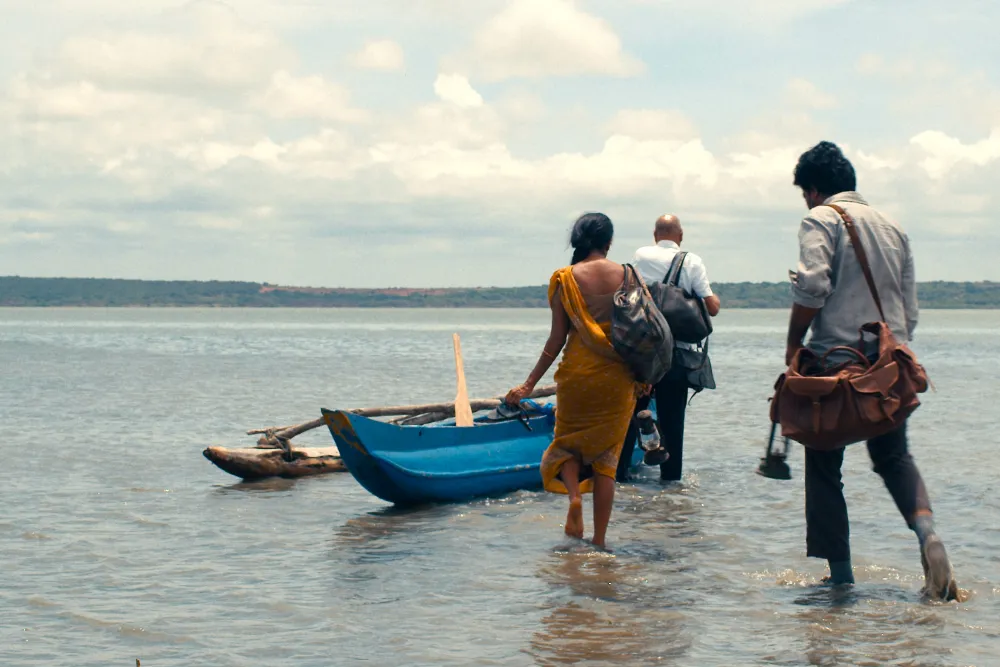
Photograph for ITFMA. All rights reserved.
In House of My Fathers, silence is not empty. It is heavy. It carries history, grief, guilt, and the weight of a land still trying to speak after decades of violence. Directed by Suba Sivakumaran, the film stands as one of the most striking works to emerge from the Eelam Tamil cinematic space, not because it follows the familiar patterns of war cinema, but because it refuses to reduce trauma into spectacle.
Released in 2018, House of My Fathers is Sivakumaran's debut feature film, but it carries the confidence of a filmmaker who understands that some wounds cannot be explained through realism alone. Instead, the film moves through allegory, myth, and magical realism, creating a world where two villages, one Tamil, one Sinhala, remain locked in the shadow of war. When both communities are struck by infertility, a message from the gods sends a Sinhala man and a Tamil woman into the Forest of the Dead, where they must confront the secrets buried by their people and their own pasts.
At its surface, the premise feels mythical. But beneath that myth is a deeply political question: what happens to a country when violence becomes inherited? What happens when generations are born into fear, separation, and stories told only from one side?
The film does not chase easy answers. It does not offer clean heroes and villains. Instead, it builds a tense emotional landscape where memory itself becomes the battlefield. The journey into the forest becomes more than a physical mission. It becomes a descent into everything left unresolved, the missing, the silenced, the dead, and the living who must carry them.
Suba Sivakumaran, a self-taught filmmaker born in Jaffna, brings a rare perspective to the film. Her background in political science, public policy, humanitarian work, and poverty alleviation gives the story a deeper awareness of conflict beyond the screen. She is not simply telling a story about war; she is exploring what war does to the human spirit after the fighting is over. Before House of My Fathers, her short film I Too Have a Name was selected for the Berlinale, and L'Oiseau Bleu was shown at Cannes Directors' Fortnight as part of the Tunisia Factory anthology. With her first feature, Sivakumaran expanded that voice into something bold, symbolic, and internationally resonant.
The film's international journey is also significant. House of My Fathers screened at major festivals including Busan International Film Festival, BFI London Film Festival, International Film Festival Rotterdam, Filmfest Hamburg, MAMI Mumbai Film Festival, FIFDH Geneva, and Seattle International Film Festival. For a film rooted in Tamil and Sinhala histories, this global circulation matters. It proves that stories from the island, especially stories shaped by Tamil memory and post-war realities, can travel far beyond regional boundaries when told with artistic courage.
Visually, the film avoids postcard beauty. The land is not presented as an escape or a tourist image. It is claustrophobic, haunted, and alive with the memory of what happened there. The forest does not simply surround the characters; it watches them. The frame becomes a place of unease, forcing the audience to feel the pressure of history closing in.
“House of My Fathers is not just a story about two villages. It is a story about inheritance, what is passed down, what is hidden, and what must finally be faced.”
At the heart of House of My Fathers is the idea that reconciliation cannot happen without truth. The film understands that peace is not just the absence of war. Peace requires memory. It requires accountability. It requires both communities to confront what they have buried. By placing a Tamil woman and a Sinhala man at the centre of the story, Sivakumaran creates a symbolic pairing that is not romanticized. Their journey is painful, uncertain, and marked by distrust. Yet through them, the film asks whether renewal is even possible without crossing into the pain of the other.
For Tamil cinema outside Kollywood, House of My Fathers is an important work. It shows that Tamil storytelling does not have to be limited to commercial formulas, star vehicles, or familiar industry systems. It can be poetic, political, experimental, and deeply rooted in lived history. It can carry the memory of Eelam Tamil experience while also speaking to universal questions of grief, division, and survival.
In many ways, House of My Fathers is not a film that simply wants to be watched. It wants to be felt. It lingers after the screen fades, asking the audience to sit with the uncomfortable truth that some histories do not disappear just because people stop talking about them.
For ITFMA, this is exactly the kind of film that deserves to be remembered and reintroduced to a wider audience. It is proof that Tamil stories exist across borders, languages, and cinematic forms. It is proof that our artists are not only preserving memory, but transforming it into powerful global cinema.
House of My Fathers is not just a story about two villages. It is a story about inheritance, what is passed down, what is hidden, and what must finally be faced.
Submissions and reader letters are welcome at itfmaconnect@gmail.com.
Related Reading
Behind Porattam, a Jaffna Creative Community Steps Onto a Bigger Stage
Behind Porattam is a network of Jaffna filmmakers, musicians and young actors now reaching cinemas across Sri Lanka and the diaspora.
At TIFF, "Till the Milk Runs Dry" Looks Beyond the Grace of the Dancer
Premiering in TIFF's Short Cuts Programme 05, Kalainithan Kalaichelvan's 12-minute Tamil-language short follows a Bharatanatyam dancer whose body becomes the site of a much larger fight.

Simone Ashley: The Tamil-British Star Rising From London Roots to Bridgerton, Sex Education, The Little Mermaid and Beyond
Behind the magazine covers and red carpets is a deeper story rooted in Tamil heritage, a British upbringing, and the determination to build a career on her own terms.