
Music
In Toronto, Yanchan Turns a Live Show Into a Portrait of the City
Presented by VETRI Promo, the producer’s latest Toronto performance brought together more than 650 people, eight surprise guests and a cross-section of the city’s musical identities.
Photograph for ITFMA. All rights reserved.
There are few cities where a single room can hold as many musical worlds as Toronto.
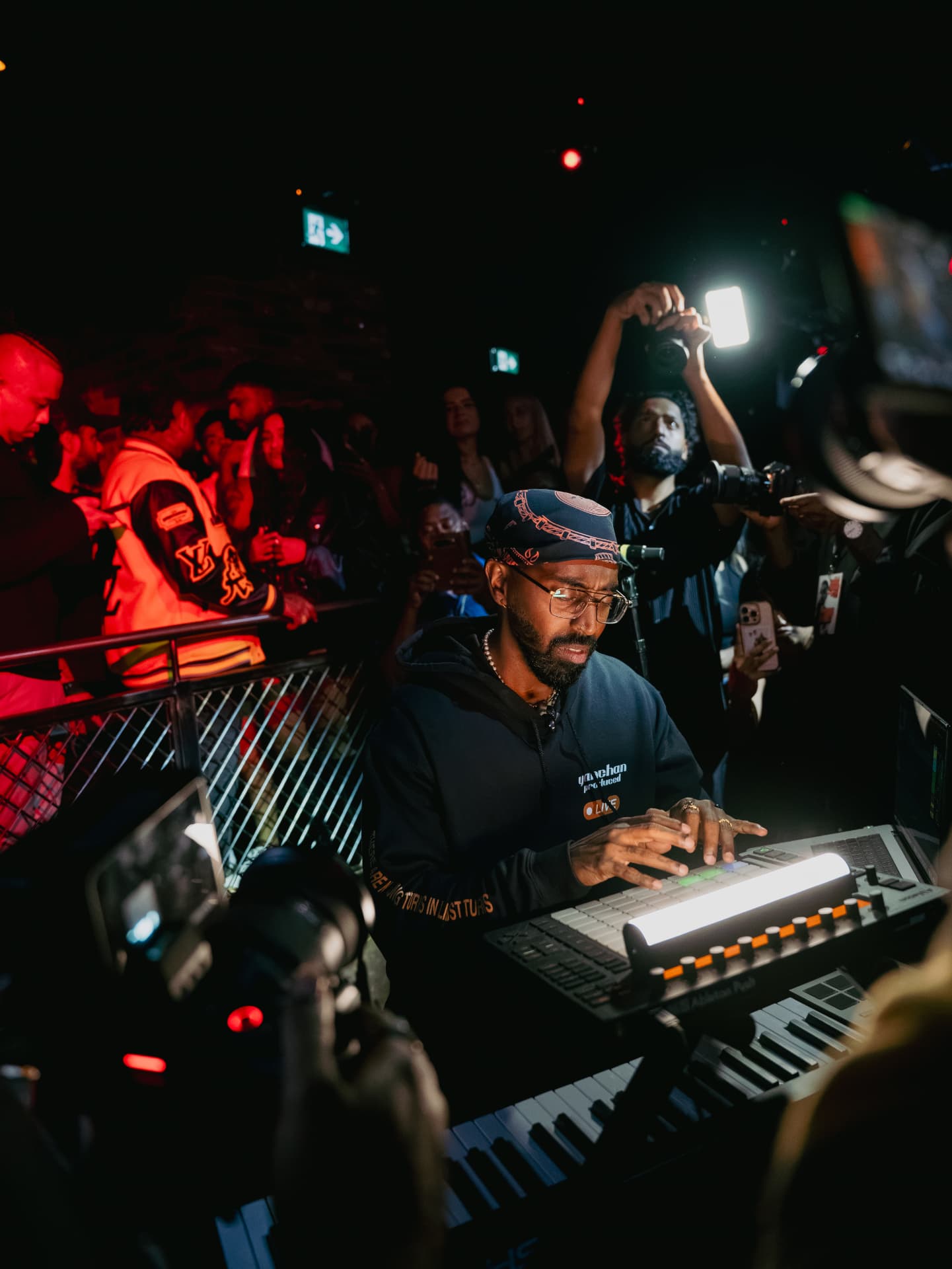
At Yanchan’s recent live performance, presented and hosted by VETRI Promo, more than 650 people gathered for an evening that moved freely between cultures, genres and generations. What unfolded was less a traditional concert than a portrait of the city that raised him, layered, unpredictable and shaped by the sounds of communities that often live beside one another before eventually finding their way into the same music.
At the centre of it all was Yanchan.
Known for a body of work that resists easy categorization, the Toronto producer used the night to showcase the range of his sonic language. Rather than keeping the focus solely on himself, he built the performance around collaboration, bringing out eight surprise artists throughout the evening: Shan Vincent de Paul, Simar, Mike Cannez, King Cruff, Dredie, Vidusan, Mitika Kanwar and Yanchan’s father, Rajmohan.
Alongside him throughout the experience was his longtime DJ and collaborator, Palm Baker, a familiar presence in Yanchan’s musical journey. Their chemistry brought another layer of continuity to a night built around collaboration, a reminder that behind an artist’s evolution are often the creative relationships that grow with them over time.
Each appearance shifted the character of the room.
The lineup crossed musical scenes, cultural backgrounds and generations, but together it made sense. That was perhaps the evening’s clearest statement.
Toronto has long been defined by its diversity, but the significance of that diversity is not simply the number of cultures that exist within the city. It is what happens when those cultures begin to influence one another.
For artists who grow up here, identity is rarely shaped by a single sound.
A child of one community may grow up listening to the music of several others, through school hallways, neighbourhoods, radio stations, house parties, clubs and friendships. Hip-hop can sit beside Tamil music. Caribbean rhythms can meet South Asian melodies. R&B, rap, electronic music and traditional instrumentation can become part of the same musical vocabulary.
Yanchan’s performance seemed to understand that instinctively.
The artists who appeared alongside him were not presented as representatives of isolated communities, but as parts of the same Toronto story. Their differences were the point.
One of the night’s most resonant moments came through the appearance of Yanchan’s father, Rajmohan Rajadurai. In a show built around the idea of musical evolution, his presence quietly connected generations, a reminder that the sounds of a city do not emerge from nowhere. They are inherited, transformed and carried forward.
The setting added to that feeling.
“A Toronto where different worlds do not merely coexist. They shape one another.”
Built around a Boiler Room style experience, the audience surrounded the music rather than observing it from a distance. The separation between performer and crowd felt intentionally reduced, creating an atmosphere that was closer to a communal gathering than a conventional stage production.
The wider sonic experience was supported by DJ Kharish, DJ Miru, DJ Evity and DJ Rocket of 3D Sound, extending the evening’s musical scope and reinforcing its celebration of Toronto’s DJ culture.
But the most compelling part of the event was not simply the number of performers, or even the size of the audience.
It was what the room represented.
Toronto is often described as one of the world’s most multicultural cities. Yet multiculturalism can sometimes become an abstract word, something used in tourism campaigns and civic branding.
Music offers a more tangible version of it.
You can hear when cultures have lived beside one another long enough to begin exchanging ideas. You can hear migration, friendship and neighbourhoods. You can hear what happens when artists stop treating cultural boundaries as borders.
On this night, Yanchan’s music became a vehicle for that exchange.
More than 650 people came to watch a producer perform. What they experienced was something broader: a demonstration of how Toronto continues to create artists who are difficult to place inside a single category because the city itself has never belonged to just one.
The result was a celebration not simply of Yanchan’s sound, but of the environment that helped create it.
A Toronto where different worlds do not merely coexist.
They shape one another.
Submissions and reader letters are welcome at itfmaconnect@gmail.com.
Related Reading
Ratty Adhiththan and a Tamil Hip-Hop Without a Single Centre
Shaped by Jaffna, Malaysia and France, Ratty Adhiththan helped widen the definition of Tamil music while staying rooted in language.
Smith Asher Steps Forward Under Anirudh’s Albuquerque Records
Singer, producer, guitarist and programmer Smith Asher steps into the spotlight with “Annakiliye,” released on Anirudh Ravichander’s Albuquerque Records.
Dhee, Lara Raj and a Borderless Tamil Future
Dhee carried Tamil music outward. Lara Raj of KATSEYE found her way in from the Western mainstream. On “Vari Vari,” their journeys meet.